
Most business owners treat the business as the retirement plan. Sell it someday, live off the proceeds. That works until it doesn’t. A buyer falls through, a partner wants out early, or the business simply stops growing the way it used to. A retirement account outside the business is the plan that doesn’t depend on someone else showing up with a check.
Once you decide to save outside the business, the next decision is which account. For a business owner with no full-time employees, it almost always comes down to two: a SEP IRA or a Solo 401(k).
The short answer: a Solo 401(k) usually lets you save more money at the same income. A SEP IRA is simpler to run and more forgiving on timing. Everything below explains why, with the actual 2026 numbers.
What a SEP IRA is
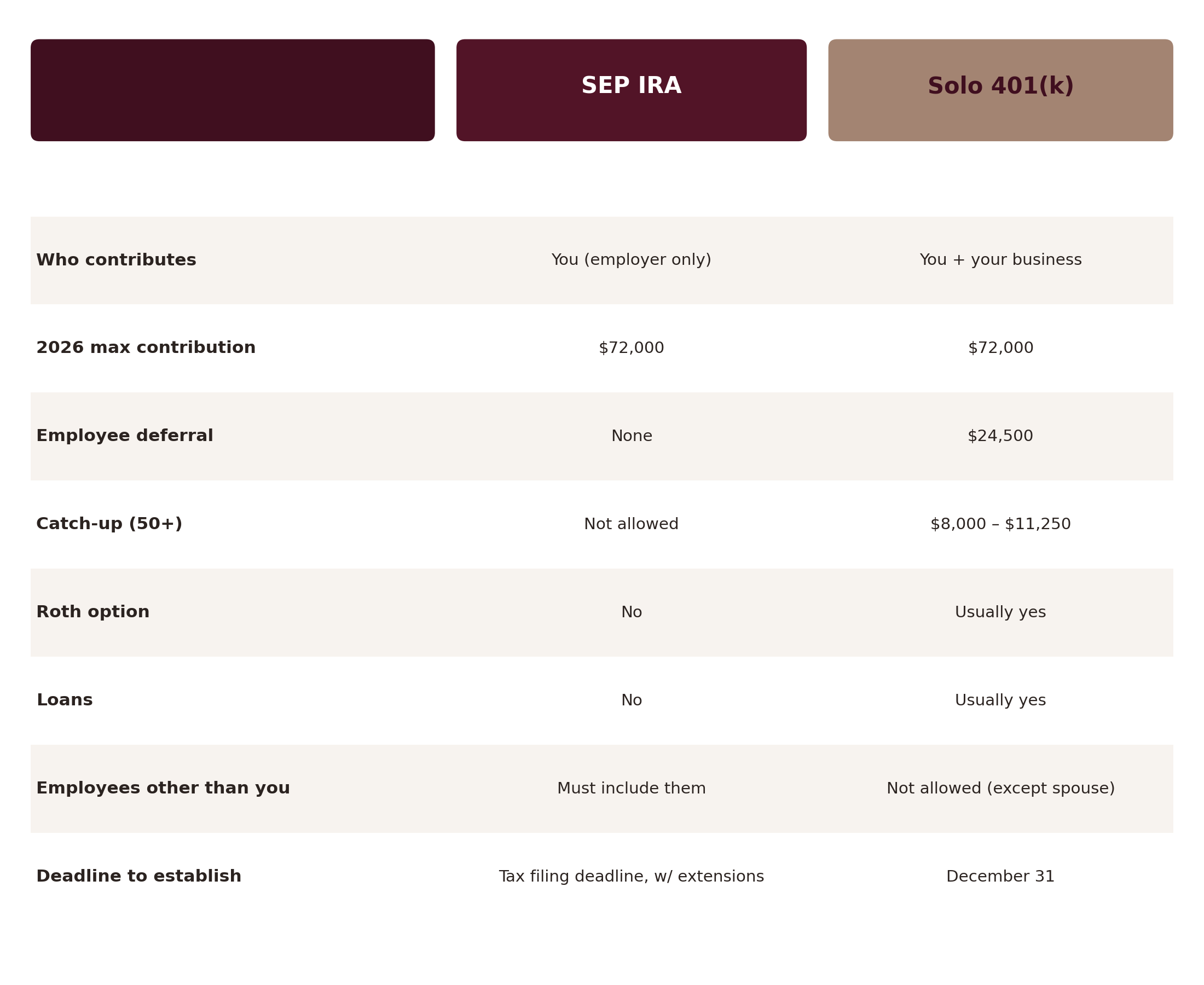
A SEP IRA is an employer contribution, full stop. You, as the business, contribute up to 25% of compensation for yourself and for any eligible employee. There’s no employee deferral. The business writes one contribution, once a year, and that’s the whole plan.
For 2026, the SEP IRA contribution cap is $72,000, capped further by 25% of compensation, with compensation itself capped at $360,000. There are no catch-up contributions for those 50 and older. There’s no Roth option. There are no loans.
What a Solo 401(k) is
A Solo 401(k) works for a business owner with no employees other than a spouse. It has two contribution types instead of one: you can defer money as an employee, and the business can contribute as an employer.
For 2026, the employee deferral limit is $24,500. Add $8,000 if you’re 50 to 59 or 64 and older, or $11,250 if you’re 60 to 63. On top of that, the business can contribute up to 25% of compensation as an employer contribution. Combined, the total cap is $72,000 for 2026, before catch-up, using the same $360,000 compensation ceiling as a SEP.
Most Solo 401(k) plans also allow Roth contributions and loans against the balance, options a SEP doesn’t offer.
Why the Solo 401(k) usually wins on dollars saved
The two plans share the same $72,000 ceiling, but they get there differently. A SEP IRA only has the employer contribution, so you need $288,000 of compensation to hit $72,000, 25% of $288,000. A Solo 401(k) reaches a similar number faster because the employee deferral of $24,500 counts on top of the employer contribution, not instead of it.
Take a business owner paying themselves $150,000 in W-2 wages. A SEP IRA caps out around $37,500, 25% of pay. A Solo 401(k) starts with the same $37,500 employer contribution, then adds the $24,500 employee deferral, landing near $62,000. That’s roughly $24,500 more, sheltered from taxes, in the same year, at the same income.
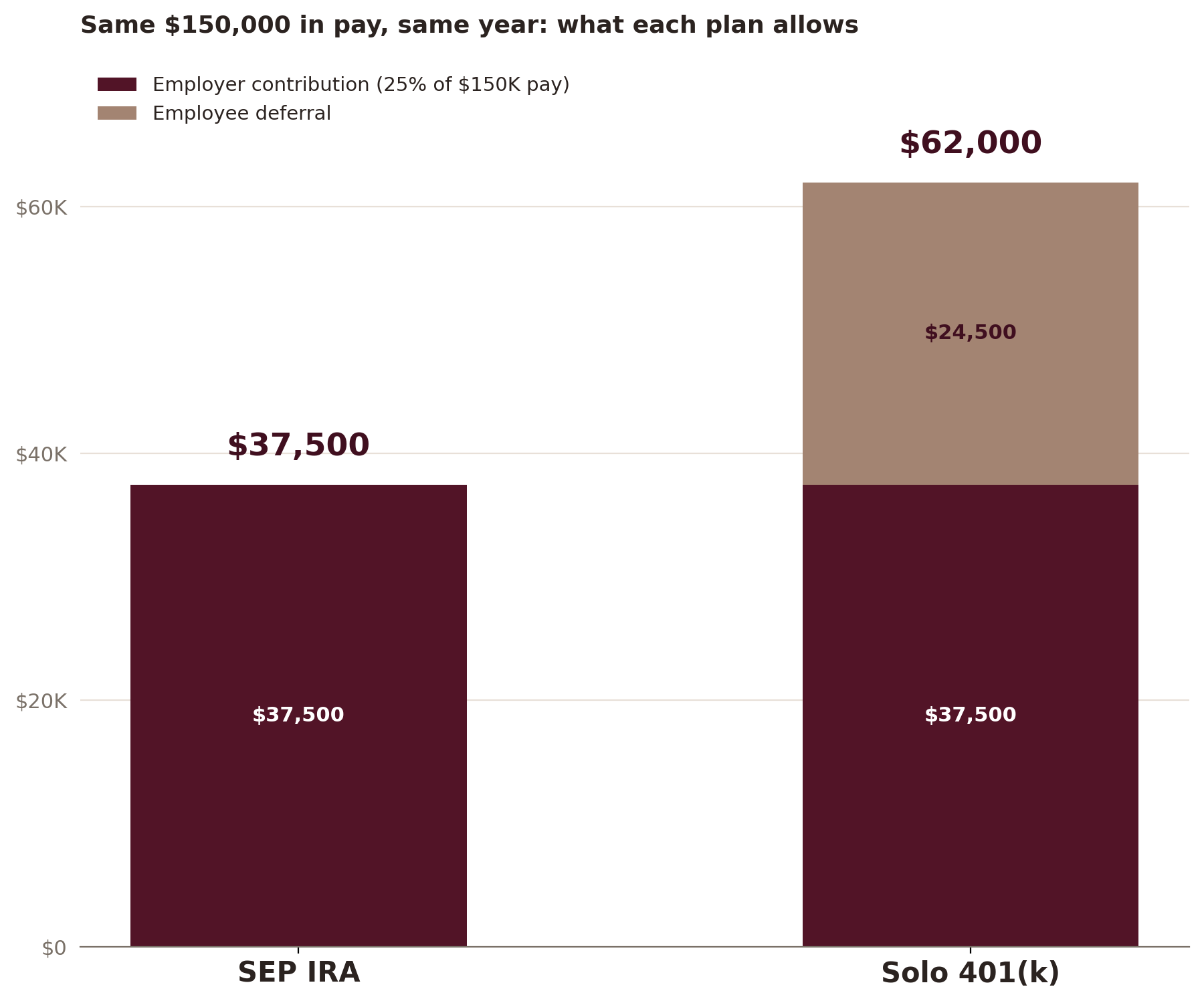
The gap narrows as income rises, since both plans hit the same $72,000 ceiling eventually. But for a business owner below that ceiling, the Solo 401(k) almost always contributes more per dollar of income.
Why the SEP IRA still has a place
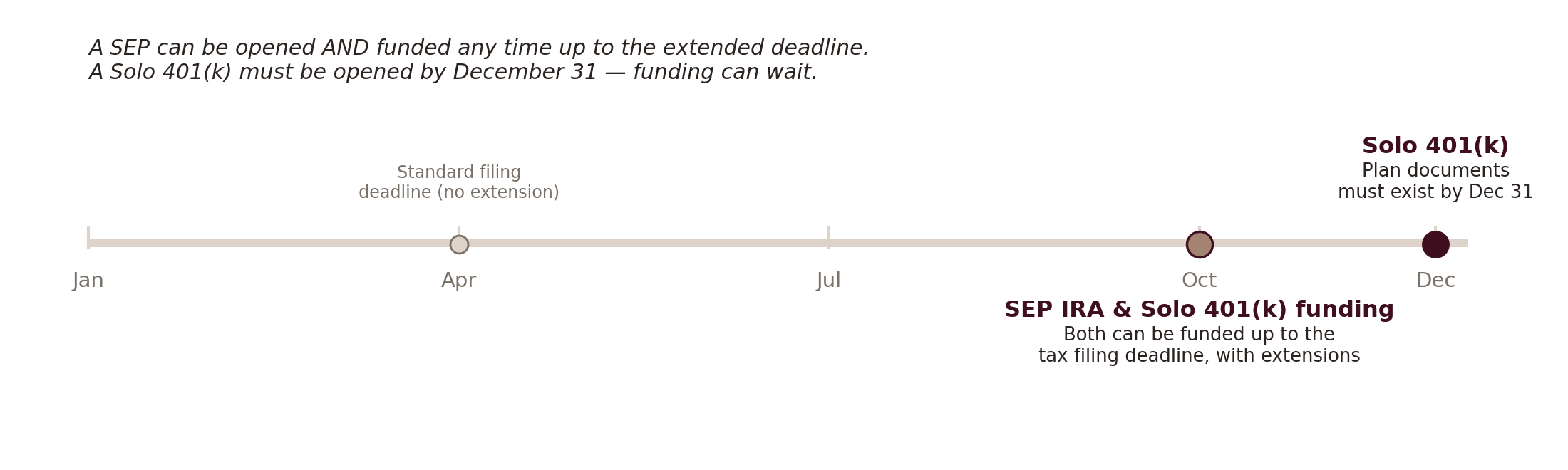
Speed and simplicity count for something. A SEP IRA can be opened and funded as late as the business’s tax filing deadline, including extensions. That means a SEP set up in September for the prior tax year is still valid. A Solo 401(k) has to be established, with signed plan documents, by December 31 of the year you want the deduction for. The funding can wait until the tax deadline, but the paperwork can’t.
A SEP also has no annual filing requirement below $250,000 in assets, no Form 5500, and nothing resembling ongoing plan administration. If the goal is one contribution a year with the least amount of friction, a SEP still does that well.
The tradeoff disappears the moment a business hires actual employees. A SEP requires the same percentage contribution for every eligible employee, age 21 and up, with a few years of service. A Solo 401(k) stops working the moment there’s a non-spouse employee on payroll. That alone decides the choice for a lot of businesses.
Which one fits your business
A SEP IRA fits a business owner who wants the least amount of plan administration, might hire employees soon, or needs the flexibility to decide on a contribution after the tax year is already over.
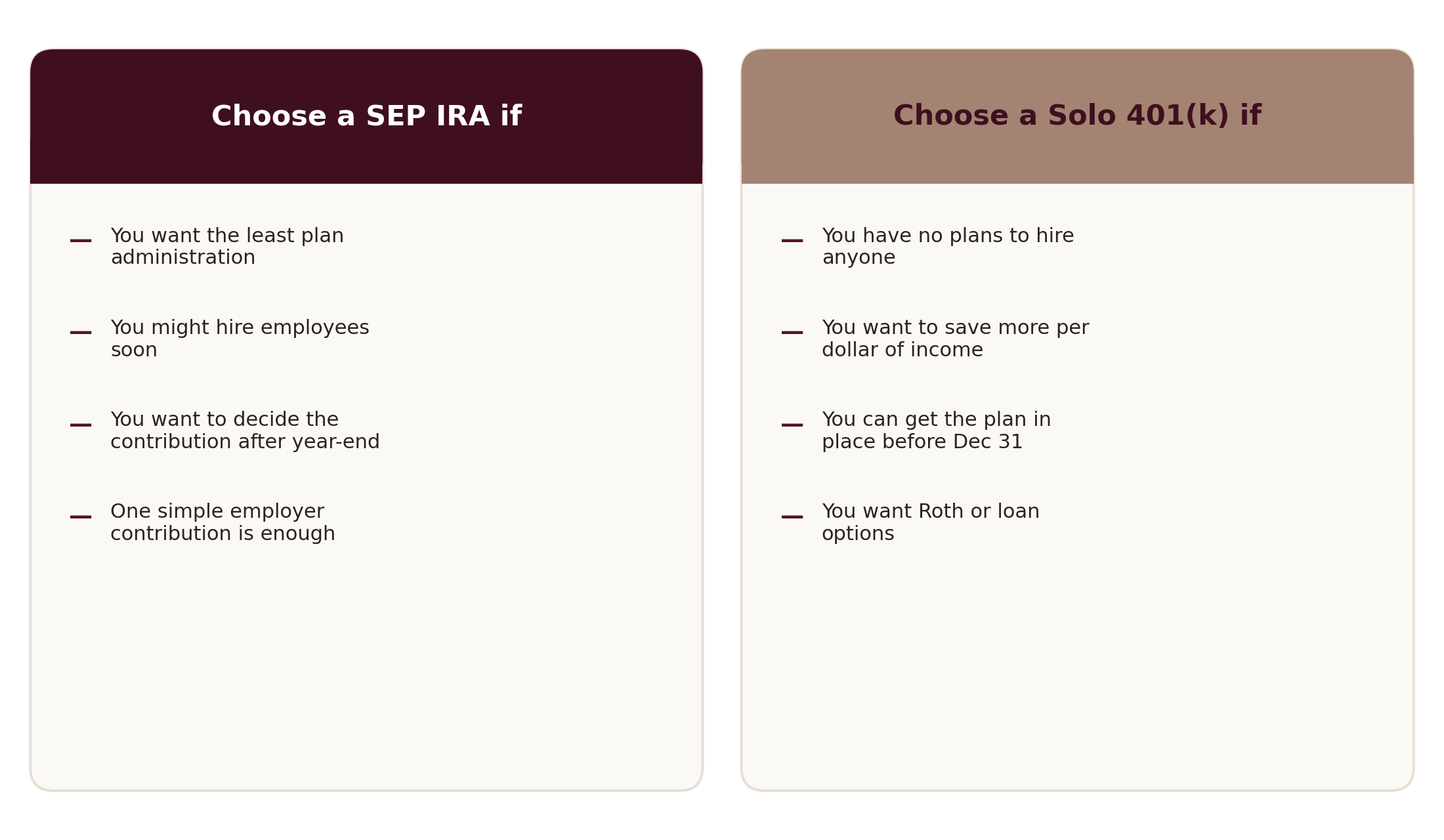
A Solo 401(k) fits an owner with no plans to hire, who wants to save more per dollar of income, and who’s organized enough to have the plan in place before December 31.
Neither answer is universal. The right one depends on income, hiring plans, and how the business fits into the rest of an estate. That’s the part a comparison chart can’t answer.
The bigger question
The account you pick matters less than what happens around it. How the contribution interacts with the rest of the estate. Whether the business itself is the biggest asset in the plan and what happens to it. Whether the tax savings today create a bigger problem in twenty years.
That’s the conversation worth having before the account is opened, not after.
Start with a Private Wealth Review. We’ll look at the business, the rest of the estate, and which retirement structure actually fits the plan for the next twenty years, not just this tax return.
